
Concrete Removal in Queens
- Home
- Concrete removal
Concrete removal is breaking out flatwork, loading it and taking it off the site. The slab comes up in pieces, the pieces leave with the carter, and you are handed bare graded ground ready for whatever goes in next.
- Driveways and parking pads
- Walkways, paths and side passages
- Patios and rear yard slabs
- Steps and stoops
- Garage and shed slabs
- Footings and old foundation remnants
It is usually the first stage of something else. A driveway comes out because a new one is going in, a rear slab comes out because the yard is being landscaped, a garage slab comes out after the garage did. We do the removal and leave you a site the next trade can work on.
Where the slab is the floor of a structure that is also coming down, that is building demolition and the two are planned as one job. Where it is an interior floor under a strip out, it sits with interior demolition.
What the job involves
Concrete jobs look simple from the street and frequently are not, because most of what decides them is not visible until it breaks.
Breaking out. The slab is broken into pieces that can actually be moved by whatever can reach the site. On an open driveway that means machinery. Behind an attached house it often means hand tools and a wheelbarrow.
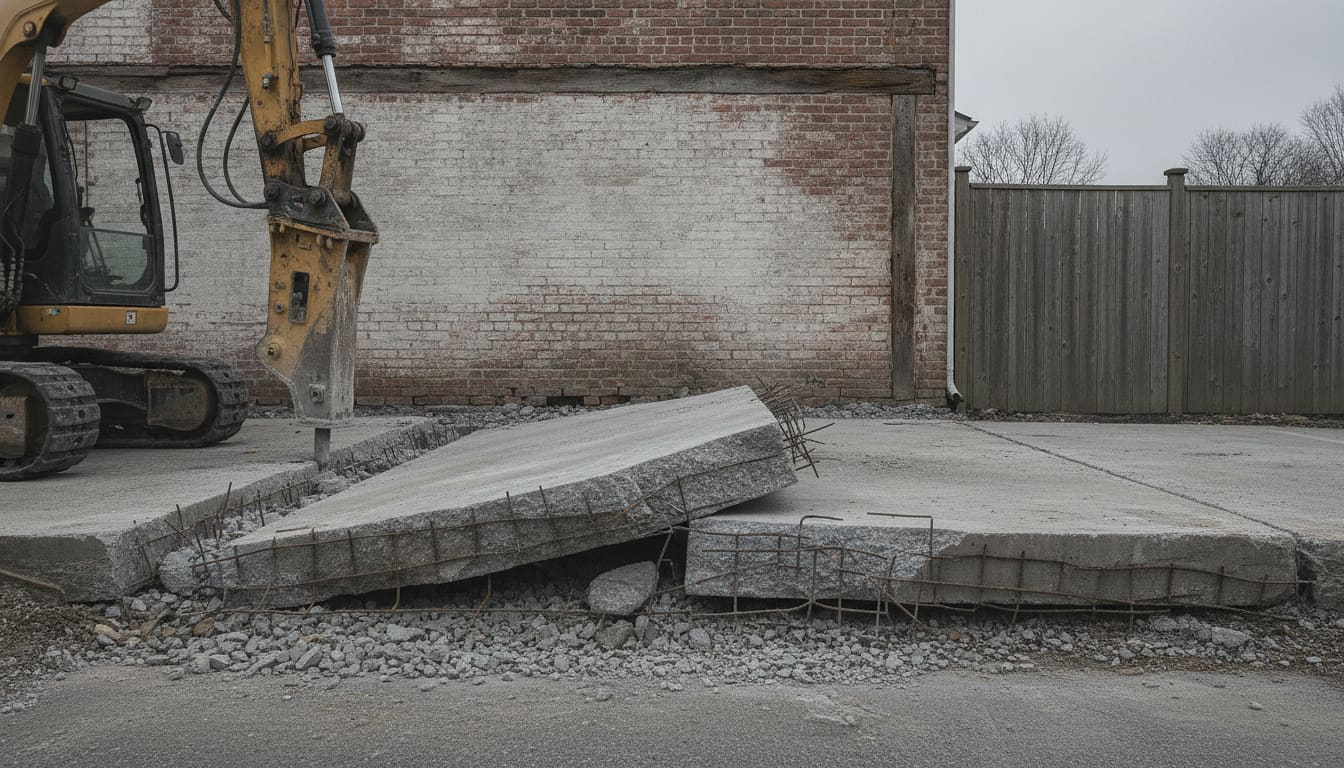
Reinforcement. Older Queens flatwork may contain mesh, rebar or no reinforcement at all, and there is no reliable way to know from the surface. Reinforced concrete comes up in sheets that have to be cut rather than in pieces that can be lifted, and it is slower.
What is underneath. Under a slab there may be clean sub-base, or fill, or an older slab that was poured over rather than removed, or a utility line nobody recorded. We find out during the survey where we can, and we tell you what we find as soon as we find it.
Clearing and leveling. Material is loaded as it comes up. The ground is left graded to the depth you asked for and clear enough to build on.
Describe the job and we will tell you what it involves.
Call (929) 205-0638Getting to it, and getting it out
This decides more about a concrete job than the concrete does.
An open front driveway with curb space is the straightforward case. Machinery reaches the slab, material goes straight into a container, and the job moves quickly.
A rear yard behind an attached house is the other case, and across much of the borough it is the common one. If the only route is a side passage a few feet wide, or through the house itself, then nothing mechanical reaches the slab and every piece comes out by hand along that route. Where we work covers which parts of Queens that describes. That is a different job at a different price, and it is why we look before quoting.
We check the route, the curb space, the alternate-side rules and the carry distance before giving you a number, because guessing at any one of them would make the number wrong.
Weight is what you are paying for
This is the part worth understanding, because it is where concrete differs from every other demolition job.
Concrete is dense. A modest-looking residential driveway can produce many tons of material, and disposal is priced on weight rather than on how large the area looked. That is why a small patio can cost more than a customer expects and why area alone is a poor guide.
Two things change the weight substantially. Thickness, which is often not what people assume and is only confirmed once the first section is broken. A four-inch path and a six-inch driveway apron differ by half again. And whether there is an older slab underneath, which doubles the volume without changing anything you can see from above.
We measure what we can before quoting and tell you where the uncertainty is, rather than pricing the optimistic version and revising it later.
Where the material goes
Broken concrete is heavy construction debris, and in New York City it leaves the site with a registered carter and has to reach a registered facility.
Because of the weight, container placement and the number of changes needed are worked out before the job rather than during it. A container that can stand at the curb next to the slab is the efficient case. One that has to stand two houses down adds a carry to every single piece.
What our removal generates, we clear.
Every job is different. Tell us yours and we will tell you what it takes.
Call (929) 205-0638What drives the cost
Area and thickness together. Area alone tells you very little. Thickness is what turns square feet into tons.
Reinforcement. Mesh and rebar mean cutting rather than lifting, and a slower job.
Access. The largest single swing. Machine access versus a hand carry down a side passage is not a small difference.
Carry distance and container placement. Every foot between the slab and the container is repeated for every piece.
What is underneath. An unrecorded second slab or unexpected fill changes the volume.
How the ground is to be left. Cleared, or graded to a depth for something specific, are different finishes.
Tell us roughly the area, where it is on the property, and whether a vehicle can get near it, and we can usually give you a range on the phone.
Tell us what you have and we will tell you what it takes.
Call (929) 205-0638Questions
What does concrete removal cost?
It is priced on weight and access, and area is the starting point for both.
Area is where to start, so a 20 by 20 pad or a thousand square feet of driveway is a useful thing to tell us. What turns that area into a price is three more things. Thickness, because a four-inch walkway and a six-inch driveway apron over the same area differ by half again in material. Reinforcement, because mesh and rebar mean cutting rather than lifting. And access, which is usually the largest of the three, because a slab a machine can reach and a slab reachable only by wheelbarrow down a side passage are entirely different jobs.
That is why two slabs of identical size can land far apart. Tell us the area, where it sits on the property, and whether a vehicle can get near it, and we can usually give you a range on the phone.
Can I remove concrete myself?
For a small, thin, unreinforced slab you can reach with a wheelbarrow, yes. People do it.
What decides it is weight and disposal rather than breaking. A breaker will get through four inches of plain concrete. The problem arrives afterwards: a 20 by 20 pad at four inches is around ten tons of material, it cannot go out with household trash in New York City, and it has to reach a registered facility with a registered carter. Hiring a container and arranging that carting is most of what you would be paying us for anyway.
The point it stops being worth it is reinforcement or a second slab underneath. Mesh and rebar have to be cut, and a slab poured over an older one doubles the tonnage without looking any different from above. If you are undecided, tell us the area and thickness and we will tell you honestly which side of the line it is on.
What is left after the concrete comes out?
Bare ground, cleared and graded, and usually a little lower than you might picture.
Once a slab and its sub-base are gone, the level drops. If something specific is going in afterwards, a new slab, pavers, planting or lawn, tell us at the survey and we will leave the ground graded to the depth that trade needs rather than to a general one.
What is underneath varies. Sometimes it is clean sub-base. Sometimes it is fill, or an older slab that was covered over instead of removed. We tell you what we find when we find it, because it changes both the volume and what you can build on.
Tell us about the slab
Roughly how big, where on the property, and whether a vehicle can reach it. That is enough to start.